
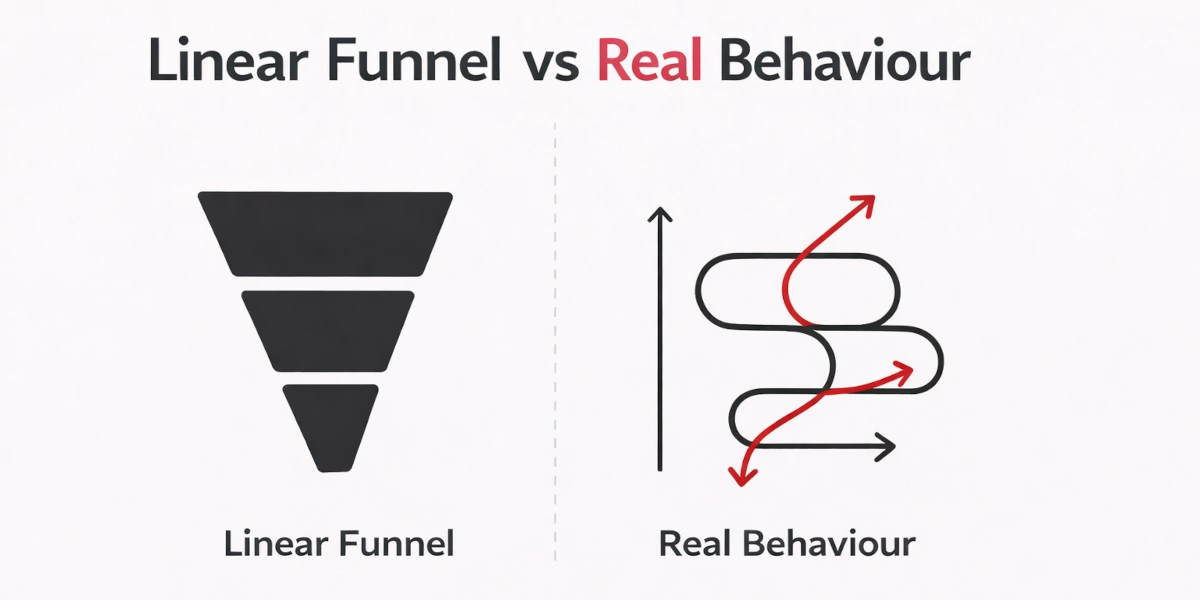
Most marketing strategies are still built around the classic funnel:
awareness → consideration → conversion.
It looks clean. It looks logical.
And in real businesses — it quietly destroys efficiency.
The core problem is simple: funnels describe reports, not people.
Customers do not move in straight lines. They hesitate, compare, leave, return, switch devices, ignore ads, talk to others, and re-enter the process from unexpected points.
When marketing is optimised for funnels instead of real customer journeys, money does not disappear dramatically — it leaks steadily, invisibly, and systematically.
Linear Funnel vs Real Behaviour
The illusion of the classic marketing funnel
Funnels were created for simplification and reporting, not for strategic decision-making.
They assume that:
- customers move step by step,
- channels have fixed roles,
- conversion happens once,
- attribution is linear and clear.
In reality:
- journeys loop and restart,
- channels overlap and influence each other,
- decisions are delayed and emotional,
- attribution is fragmented and partial.
Funnels compress complexity into neat stages — and in doing so, they hide friction, confusion, and waste.
That is why funnel-based optimisation often improves metrics while profitability stays flat.
Customer journey is not a model — it is behaviour
A customer journey is not a diagram.
It is the sum of real interactions between a person and your brand over time.
It includes:
- multiple entry points,
- repeated exposure across channels,
- online and offline touchpoints,
- emotional triggers,
- trust erosion and recovery.
Journeys are:
- non-linear,
- channel-agnostic,
- time-dependent,
- context-driven.
When marketing ignores this reality, optimisation happens in isolation — ads are improved, landing pages are tweaked, emails are refined — but the system itself remains broken.
Where businesses actually lose money
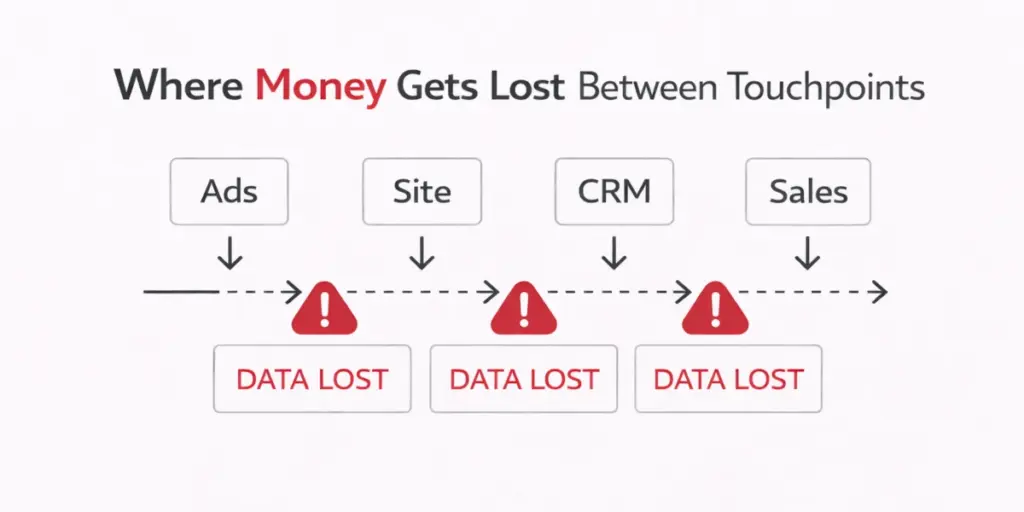
Most losses do not happen at the point of conversion.
They happen between touchpoints, where responsibility, data, and intent break down.
Where Money Gets Lost Between Touchpoints
1. Broken attribution logic
Last-click and platform-centric attribution reward visibility, not influence.
Budgets are shifted based on incomplete signals, while effective touchpoints are undervalued or removed.
2. Channel silos
Paid media, website, CRM, sales, and retention teams operate with different KPIs and dashboards.
No one owns the full journey — so no one sees the full picture.
3. Loss of intent between interactions
Customers click, hesitate, leave, return — but intent is rarely preserved.
Each re-entry resets context instead of continuing the conversation.
4. Retention treated as an afterthought
Funnels end at conversion.
Journeys continue — and most lifetime value is either created or destroyed after the first purchase.
Why traffic reports mislead CEOs
High traffic does not equal growth.
Good ROAS does not equal profitability.
Common reporting illusions include:
- ROAS without margin context,
- CPL without lifetime value,
- conversion rates without journey depth,
- dashboards without behavioural insight.
What looks like optimisation is often just re-labelling spend, not improving outcomes.
This is why leadership teams frequently feel something is wrong — even when reports look “green”.
From funnel optimisation to journey control
The goal is not to abandon funnels.
The goal is to stop using them as decision engines.
Customer journey control means:
- mapping real behavioural paths,
- identifying friction between touchpoints,
- aligning data, messaging, and ownership,
- optimising for continuity, not clicks.
Customer Journey As a Managed System
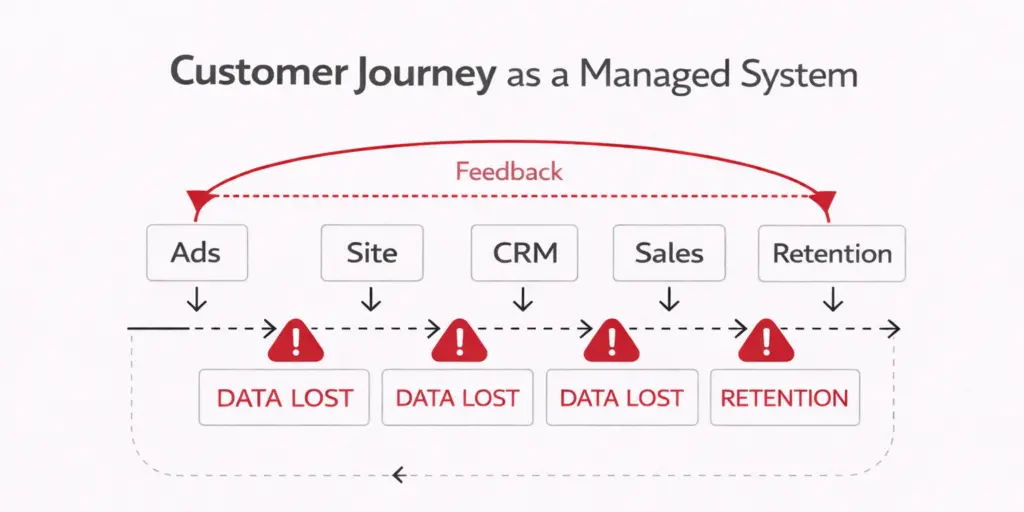
When journeys become visible:
- marketing stops being reactive,
- spend becomes intentional,
- decisions become explainable,
- efficiency becomes structural — not accidental.
The shift businesses actually need
Businesses do not grow because they buy more traffic.
They grow because they understand and control how customers move, decide, and return.
Funnels describe outcomes.
Customer journeys explain why those outcomes happen.
And only one of them shows where the money is really going.