
How businesses align digital advertising with real customer decisions to reduce wasted ad spend and increase revenue predictability
Executive Context: Why This Topic Matters for Business
Digital advertising has become one of the largest and fastest-growing expense categories for small and mid-sized businesses. According to industry estimates, global digital advertising spend exceeded $600 billion in 2024 and continues to grow year over year.
At the same time, the effectiveness of this spending remains questionable. Multiple independent studies consistently show that 60–70% of digital advertising budgets are spent inefficiently, primarily due to structural misalignment rather than poor execution.
Additional findings highlight that:
- more than 50% of business owners do not fully trust advertising performance reports
- most underperforming campaigns fail due to strategic errors, not creative or technical ones
The core issue is not whether digital advertising works — it is whether it aligns with how customers actually make decisions.
Customer Journey Advertising addresses this gap by shifting advertising from channel-centric execution to decision-centric strategy.
Why Digital Advertising Fails Before Metrics Turn Red
Most businesses identify advertising problems only after performance metrics deteriorate — rising acquisition costs, declining conversion rates, or unstable revenue. By that stage, the damage has already occurred earlier in the funnel.
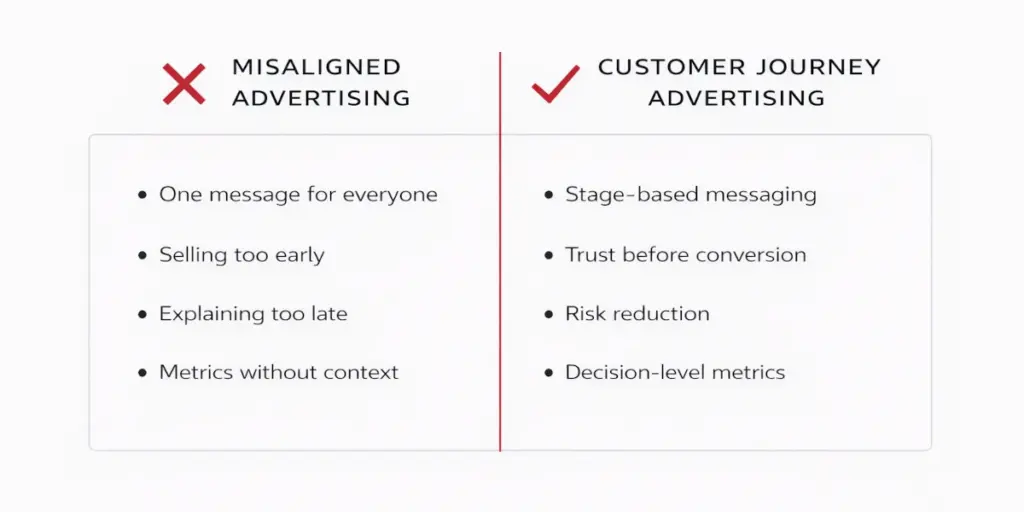
The most common structural causes include:
- Selling too early
Transactional messages shown to cold audiences result in low engagement and inflated costs. - Explaining too late
High-intent users receive discounts instead of clarity, proof, or reassurance. - One message for all stages
Advertising platforms optimise delivery mechanics, not customer readiness.
As a result, businesses optimise surface-level metrics while losing control over real business outcomes: predictability, efficiency, and trust.
Understanding the Customer Journey
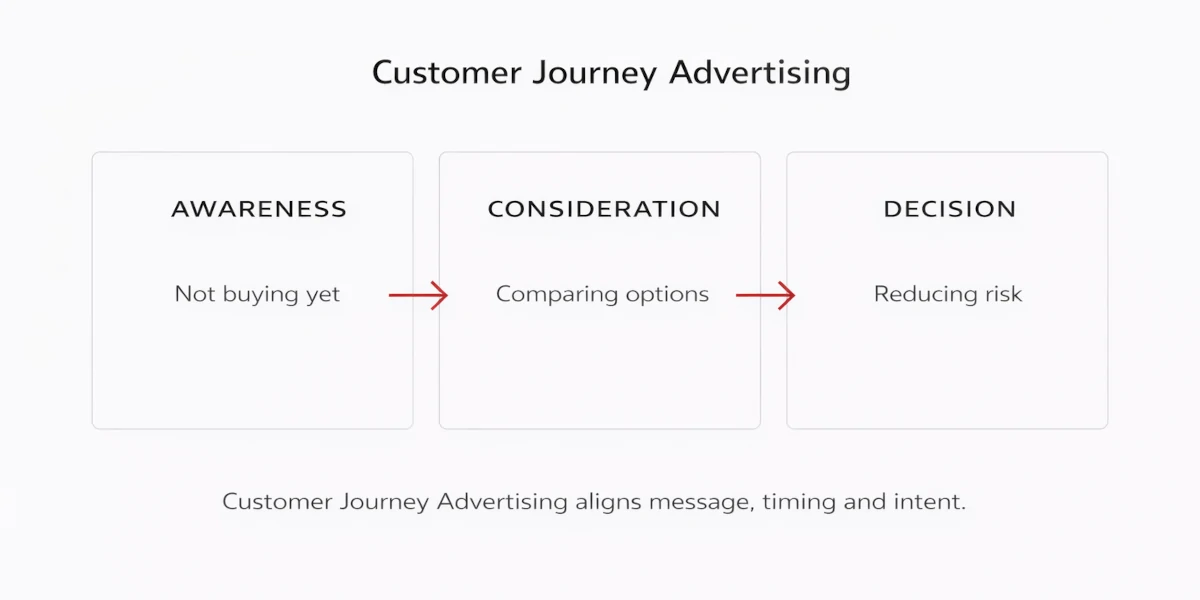
The customer journey is commonly described as three stages: awareness, consideration, and decision.
From a business perspective, these stages represent three different decision environments with different risk perceptions.
Awareness Stage: Why Most Advertising Is Ignored
At the awareness stage, the customer is not ready to buy.
Research shows that only 3–5% of a total market is actively in purchase mode at any given time. This means that more than 90% of advertising impressions reach people who are not currently seeking a solution.
Effective awareness advertising focuses on:
- problem recognition
- category understanding
- relevance and familiarity
Educational and problem-oriented content has been shown to:
- reduce future cost per acquisition by 20–40%
- increase brand recall by 2–3×
The primary objective at this stage is mental availability, not immediate conversion.
Consideration Stage: Where Trust and Differentiation Are Decided
The consideration stage is the highest-leverage point in the customer journey.
During this phase, customers actively compare options and evaluate credibility. Performance data indicates that brands supporting customers during evaluation outperform competitors by 30–50% in conversion efficiency.
At this stage, customers seek:
- proof of outcomes
- logical explanations
- expert validation
- reduced uncertainty
Businesses that invest here experience:
- shorter sales cycles
- higher average order values
- lower reliance on discounts
Trust compounds faster than reach.
Decision Stage: Turning Intent into Revenue
At the decision stage, motivation already exists.
The primary remaining barrier is risk perception.
Research into purchase abandonment shows that approximately 69% of buying decisions fail due to friction, unclear information, or lack of reassurance — not lack of intent.
Effective decision-stage advertising focuses on:
- clear next steps
- transparent pricing
- guarantees and reassurance
- operational clarity
This stage is not about pressure. It is about confidence transfer.
Data, Measurement and the Illusion of Control
Many businesses consider themselves data-driven, yet most reporting systems mix signals from different journey stages. This aggregation creates misleading conclusions and false optimisation signals.
A stage-based measurement approach restores clarity:
Awareness stage metrics focus on reach and attention.
Consideration metrics measure depth, engagement, and trust formation.
Decision metrics evaluate conversion efficiency and revenue execution.
Separating these metrics prevents distorted optimisation and supports informed decision-making.
Segmentation and Personalization Without Overengineering
Personalization can improve conversion rates by up to 26%, but over-personalization without context erodes trust.
Effective segmentation is behaviour-based and aligned with journey stages rather than demographics alone. Relevance, not complexity, drives performance.
Testing, Optimization and Budget Reallocation
High-performing businesses optimise advertising by:
- aligning messages with decision stages
- reallocating budgets dynamically
- prioritising marginal ROI over vanity metrics
This approach stabilises acquisition costs and reduces revenue volatility.
Omnichannel Strategy Without Chaos
Omnichannel does not mean being present everywhere.
It means delivering a consistent narrative and timing across touchpoints.
Customers exposed to coherent omnichannel experiences demonstrate higher spending levels and stronger lifetime value — but only when messaging aligns with decision stages.
Conclusions for Business Owners and CEOs
Customer Journey Advertising is not a marketing tactic.
It is a control framework.
Businesses that apply it:
- reduce wasted advertising spend
- shorten decision cycles
- improve revenue predictability
- restore trust in performance data
The competitive advantage is not better ads —
it is better alignment between money, message, and moment.